Summarize with ChatGPT Claude Perplexity
TL;DR
- Finseo is the clearest documented fit for multi-market healthcare visibility monitoring because it publishes country coverage, an Enterprise 23-model tier, public pricing, and a pharma Fact Check feature.
- Profound has the strongest published security evidence in this review because its Trust Center names a SOC 2 Type II attestation with HIPAA coverage.[8]
- No reviewed platform publicly documents automatic validation of every AI answer against current approved product information or complete off-label classification.
- AI visibility should support, not replace, medical-information, regulatory, and pharmacovigilance review because drug-answer accuracy varies materially by question set and model.
- Before procurement, require evidence for market scope, approved-source testing, BAA/DPA terms, data residency, retention, subprocessors, AI-training use, and answer-history export.
What should healthcare buyers expect from AI visibility platforms?
For healthcare and pharmaceutical brands, Finseo is the strongest documented fit when the buying brief prioritizes multi-market visibility tracking, public pricing, and health-sector examples; Profound has the strongest published security evidence because its Trust Center names SOC 2 Type II with HIPAA coverage. None of the reviewed platform materials documents systematic validation of every generated answer against current approved product information or automatic off-label classification, so medical, regulatory, and pharmacovigilance review remains necessary.
AI visibility software should therefore be treated as a monitoring and evidence-collection layer, not as a medical-information approval system. The reviewed products document capabilities such as prompt monitoring, brand mentions, citations, sentiment, competitors, markets, and optimization, but not a complete approved-label accuracy workflow.
That distinction matters because drug-answer quality varies significantly by question set, model, reference material, and scoring method. Published studies reported results ranging from 26% satisfactory answers in one medication-question study to 70% accuracy for one system in a 20-question comparison.[1][2]
How do Finseo, Profound, Scrunch, Peec AI, and Semrush compare on features, security, and pricing?
Table 1. Healthcare and pharma AI visibility platforms
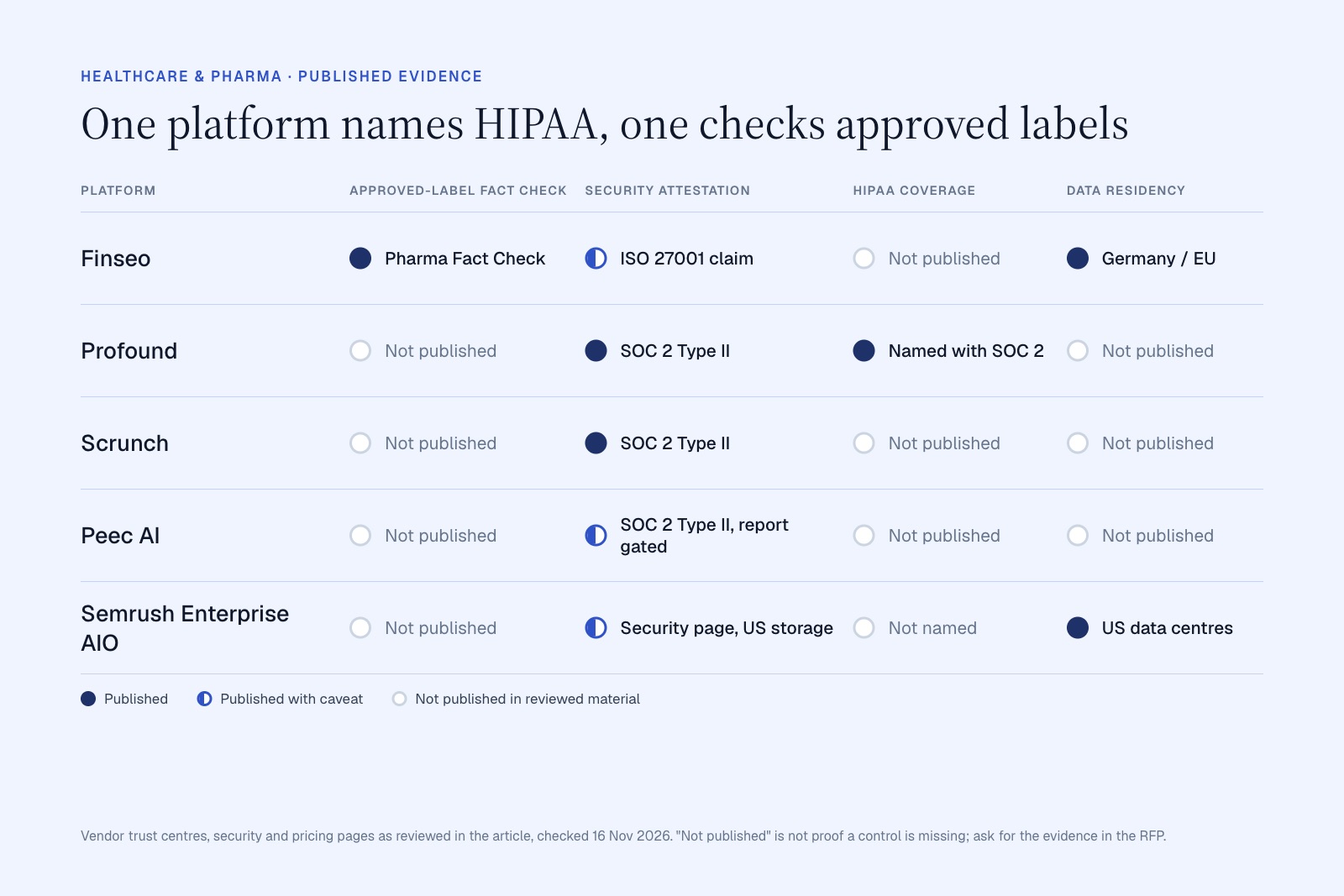
| Platform | Accuracy/fact-check feature | Markets | Security evidence | Data residency | Pricing model |
|---|---|---|---|---|---|
| Finseo | Pharma-specific Fact Check checks claims in AI answers against approved labels from regulator registries; the reviewed material does not establish that this feature covers every general visibility answer or automatically detects all off-label statements.[3] | Prompts tracked in 40+ countries and languages; Enterprise lists all 23 AI models.[4] | Pricing page makes an ISO 27001 claim; HIPAA coverage and a BAA were not published in the reviewed material.[5][4] | Hosted in Germany with EU data residency, according to the product fact sheet; obtain contractual confirmation for the intended workflow.[6] | Self-serve plans list EUR 84–479 monthly, or EUR 70–399 monthly equivalents when billed annually; Enterprise is custom.[4] |
| Profound | Prompt, mention, citation, sentiment, ranking, and competitor tracking are documented; approved-label and off-label checking were not published in reviewed materials.[7] | Structured prompts and enterprise customization are documented; comparable market breadth was not established in the reviewed sources. | Trust Center names SOC 2 Type II with HIPAA coverage.[8] | Not published in the reviewed material. | Enterprise pricing is custom.[9] |
| Scrunch | Visibility and enterprise search optimization are documented; approved-label and off-label checking were not published.[10] | The reviewed sources did not establish comparable multi-market coverage. | SOC 2 Type II, GDPR, CCPA, and a public Trust Center are documented.[11] | Not published in the reviewed material. | Price not published in reviewed sources. |
| Peec AI | AI search visibility monitoring is documented; approved-label and off-label checking were not published.[12][7] | The reviewed sources did not establish comparable multi-market coverage. | Trust Center lists GDPR, SOC 2 Type II, a DPA, and an information-security policy; the SOC 2 report is access-gated.[13][8] | Not published in the reviewed material. | Price not published in reviewed sources. |
| Semrush Enterprise AIO | Mentions, citations, sentiment, market/product/city drilldowns, content scoring, and analytics connections are documented; approved-label and off-label checking were not published. | Market-level coverage is documented in the reviewed product material. | Security page describes US data-center storage but does not name HIPAA/BAA evidence in the reviewed material. | US data centers, according to the reviewed security page.[14] | Enterprise price not published in reviewed sources. |
Checked against the reviewed public vendor and research materials on 16 November 2026. “Not published” means the reviewed sources did not disclose the item; it does not prove that a vendor cannot provide it.
How we compared the platforms
The comparison uses five criteria relevant to regulated health brands:
- Medical-information controls: Whether the reviewed material documents approved-label, fact-checking, off-label, or other accuracy controls.
- Monitoring scope: Whether the platform documents prompt, citation, competitor, engine, market, or product-level monitoring.
- Security and procurement evidence: Whether public materials identify SOC 2, HIPAA coverage, GDPR, a DPA, a BAA, or comparable controls.
- Data-location transparency: Whether the reviewed sources state where customer or service data is stored.
- Commercial clarity: Whether prices, plan limits, and enterprise conditions are publicly documented.
These criteria separate what a platform demonstrably monitors from what a regulated organization must validate independently. Pharmacovigilance guidance says marketing authorization holders should regularly screen digital media under their management or responsibility for potential adverse-reaction reports; it does not establish that every independent AI answer automatically falls within that scope.[15]
1. Finseo: which tool tracks healthcare brand visibility across ChatGPT, Claude, Perplexity, and Gemini?
Finseo tracks brand visibility across ChatGPT, Gemini, Google AI Overviews, Google AI Mode, Claude, Perplexity, Copilot, Grok, DeepSeek, Mistral, and additional regional engines. Its Enterprise tier lists all 23 AI models, while self-serve brand plans track three selected models simultaneously.[4] For procurement teams, Finseo combines hosting in Germany with a data processing agreement (DPA) for every organisation, and a German AVV is available on request (enterprise details).
Finseo is built by the team behind this site.
Key features
- Daily or weekly prompt tracking across selected AI engines, with visibility, mention, citation, share-of-voice, position, sentiment, and competitor metrics.
- Prompt research using keyword data, People Also Ask questions, AI fan-outs, Search Console, product information, and forum discussions.
- Citation-source analysis showing cited pages, domains, citation counts, and the engines that cite each source.
- Multi-market prompt tracking in 40+ countries and languages, according to the product fact sheet.[16]
- A pharma-specific Fact Check feature that checks claims against approved labels from regulator registries including FDA DailyMed, EMA, MHRA, AEMPS, and PMDA; the feature is described as an add-on.[3][17]
- AI traffic analytics, attribution, crawler analytics, tasks, content optimization, reports, API access, and an MCP server at the relevant plan levels.
Strengths
- The reviewed materials provide the clearest public pricing and plan limits.
- The platform documents health-sector examples, including an anonymized eye-drop brand and a lipedema clinic group.
- Its German hosting and EU data-residency positioning may fit European procurement requirements, subject to contractual verification.[18]
- Enterprise documentation includes custom prompt setup, all 23 listed models, unlimited projects, SSO/SAML, audit trail, onboarding, and managed service.
Limitations
- The reviewed materials do not establish that every generated health answer is automatically checked against current approved product information.
- The health-sector case studies report visibility gains, not medical correctness, approved-label consistency, or off-label detection.
- HIPAA coverage and a BAA were not published in the reviewed materials.[8]
- Only three models can run simultaneously on self-serve brand plans; regional engines require sales setup.
Pricing checked 16 November 2026
- Starter: EUR 84 monthly, or EUR 70 monthly equivalent billed annually.
- Business: EUR 210 monthly, or EUR 175 monthly equivalent billed annually.
- Growth: EUR 479 monthly, or EUR 399 monthly equivalent billed annually.
- Enterprise / Managed Service: custom.
Verdict
Best for healthcare and pharma teams that need documented multi-market visibility monitoring, public pricing, and a separate pharma fact-check capability—but are prepared to keep medical approval and procurement validation outside the visibility dashboard.
2. Profound: which AI visibility platform has the strongest published HIPAA evidence?
Profound documents structured prompts, brand appearance, citations, sentiment, rankings, and competitors. Enterprise users can edit, disable, or add prompts, which may help teams maintain a controlled monitoring set.
Its Trust Center explicitly lists a SOC 2 Type II attestation with HIPAA coverage, independently examined by Sensiba LLP.[8] That makes Profound the strongest option in this review for publicly documented HIPAA-related assurance.
Strengths
- Customizable enterprise prompt monitoring is documented.
- The Trust Center names SOC 2 Type II with HIPAA coverage.[8]
- The platform covers visibility, citations, sentiment, rankings, and competitive tracking.
Limitations
- A signed BAA was not published in the reviewed Trust Center material.[8][11]
- Approved-label validation and automated off-label detection were not published in the reviewed sources.[7]
- Comparable multi-market coverage was not established from the reviewed materials.
- Enterprise pricing is custom.
Verdict
Best for procurement teams that prioritize publicly documented HIPAA-related assurance and customizable prompt monitoring, subject to obtaining the actual attestation scope and contractual BAA terms.
3. Scrunch — enterprise security documentation with important gaps
Scrunch’s reviewed materials describe enterprise AI-search optimization and state that the company has SOC 2 Type II, GDPR, and CCPA coverage. Its public Trust Center is described as containing audit reports, security and data-handling policies, data-collection information, and subprocessors.[11]
Strengths
- Public security and trust documentation is available.[8][11]
- SOC 2 Type II, GDPR, and CCPA are documented in the reviewed FAQ material.[11]
- The platform is positioned for enterprise AI-search optimization.[10][12]
Limitations
- HIPAA coverage and a BAA were not published in the reviewed pages.[8]
- Approved-label, medical-accuracy, and off-label checks were not published.
- Comparable multi-market monitoring detail was not established from the reviewed sources.
- Price was not published in the reviewed sources.
Verdict
Best for enterprise buyers willing to complete a documentation-led security review and separately design medical-content validation and market coverage tests.
4. Peec AI — SOC 2 and DPA evidence, with access-gated detail
Peec AI’s Trust Center lists GDPR, SOC 2 Type II, a DPA, and an information-security policy. It also describes production-database authentication and restricted access to encryption keys; the SOC 2 report is available through a request-access process.[13]
Strengths
- Public Trust Center and DPA evidence are documented.[8][11]
- SOC 2 Type II is listed, with further report access gated.[8]
- Technical security controls are described in the reviewed Trust Center material.[8][11]
Limitations
- HIPAA coverage and a BAA were not published in the reviewed Trust Center material.[8]
- Approved-label and off-label checking were not published.
- The reviewed sources did not establish comparable multi-market coverage.
- Price was not published in the reviewed sources.
Verdict
Best for buyers that want a documented SOC 2/DPA review path and can obtain restricted security materials before evaluating regulated-data workflows.
5. Semrush Enterprise AIO: does it track mentions, citations, and sentiment by market?
Semrush Enterprise AIO documents mentions, citations, sentiment, market, product, and city drilldowns, AI/SEO content scoring, and GA4 or Adobe connections. Its security page says service data is stored in physically secure US data centers.[14]
Strengths
- Market, product, and city drilldowns are documented.
- The platform connects visibility monitoring with content scoring and analytics.[12]
- US data-center storage is stated in the reviewed security material.[19][20]
Limitations
- The reviewed security page does not name HIPAA or BAA evidence.
- Approved-label and off-label checking were not published.
- Certification names and enterprise pricing were not published in the reviewed pages.
- US storage may not meet an organization’s EU or country-specific residency requirements.[11][18]
Verdict
Best for enterprise teams already standardized on Semrush and seeking broad AI-search visibility and optimization workflows, provided the organization accepts the documented data-location model and adds medical review controls.
Which platform fits each healthcare procurement scenario?
- Need the strongest published HIPAA-related evidence: Start with Profound, then request the attestation scope, BAA, subprocessors, retention terms, and permitted data types.
- Need transparent self-serve pricing and multi-market visibility: Start with Finseo; validate its enterprise data-processing terms and the scope of its pharma Fact Check before production use.[3]
- Need German or EU data residency: Evaluate Finseo first because its product materials state German hosting and EU data residency; confirm this in the DPA and contract.[21][3]
- Need US data-center disclosure: Semrush documents US data-center storage, but buyers should confirm whether that location is compatible with their internal and regulatory requirements.
- Need a public SOC 2 and DPA review path: Compare Scrunch and Peec AI, while noting that the reviewed materials did not publish HIPAA/BAA evidence for either.
- Need approved-label medical validation: Do not assume any reviewed platform provides it as a complete visibility workflow; require a controlled demonstration against current local product information.[11]
- Need pharmacovigilance monitoring: Map owned, paid, and controlled channels with PV and legal teams rather than treating every independent AI answer as automatically in scope.[15]
What does AI visibility monitoring need to measure in pharma?
A useful regulated-health monitoring program should preserve more than a visibility percentage. Each observation should retain the prompt, engine, market, language, date, answer text, cited sources, competitor mentions, and the approved reference version used for review.
1. Answer accuracy
Medical-information reviewers should classify answers as accurate, incomplete, unsupported, outdated, contradictory, or clinically unsafe against the relevant approved source. Published drug-answer studies show why a single overall model score is insufficient: one study found 88.7% mean accuracy but still reported 26% of assessed answers below 100% and 3.3% scoring zero.[1]
2. Off-label and unauthorized claims
The ABPI Code says medicines must not be promoted before authorization and that promotion must accord with the authorization and not conflict with the SmPC.[7] FDA guidance on scientific information concerning unapproved uses applies to qualifying communications to healthcare providers regardless of medium, but it is not a general rule that every AI answer is promotional communication.[17]
3. Source quality and citation stability
Citations can change rapidly. Finseo’s DACH-focused sample found that next-day same-prompt citation repetition ranged from 31.6% for Google AI Overviews to 65.5% for Perplexity.[21] Teams should retain recurring snapshots rather than relying on a one-time answer.
4. Safety-signal routing
EMA GVP Module VI says marketing authorization holders should regularly screen internet or digital media under their management or responsibility for potential suspected adverse-reaction reports.[15] The monitoring design should therefore identify channel ownership, define escalation criteria, and connect relevant signals to existing PV procedures.
5. Market and language differences
The same prompt can produce different answers across countries, languages, models, and approved product information. A procurement test should include local brand names, generic names, indications, contraindications, dosing, safety questions, patient questions, HCP questions, and deliberately off-label prompts.
What should a healthcare procurement checklist include?
Use this checklist before signing an enterprise contract:
- Approved-information test: Can the vendor demonstrate answer comparison against the current local label, SmPC, prescribing information, or other approved reference?
- Off-label test: Can the workflow identify unsupported indications, unauthorized claims, and dosage or population statements outside the approved information?
- Human accountability: Which medical, regulatory, and PV users review findings, and can the platform record decisions and reviewer evidence?
- Market coverage: Which engines, countries, languages, markets, and model versions are included, and are regional engines separately priced?
- Evidence retention: Can the platform export prompt, answer, citation, market, engine, date, and source history?
- Security scope: Request the SOC 2 report or attestation, certification scope, penetration-test summary, subprocessors, access controls, incident commitments, and deletion terms.
- BAA and DPA: If protected health information or other regulated data could enter the workflow, request the applicable BAA and DPA before production processing.
- Data residency: Confirm storage, support access, backups, subprocessors, disaster recovery, and cross-border transfers.
- AI-training terms: Confirm whether customer prompts, answers, documents, or telemetry are used to train vendor or third-party models.
- Integration boundaries: Identify what enters analytics, CRM, CMS, project-management, or AI-agent integrations.
- Retention and deletion: Establish retention periods, legal holds, export rights, deletion verification, and account-closure procedures.
- Acceptance benchmark: Run a representative set of local-label and off-label prompts, scored by medical-information and safety experts before rollout.
What evidence should procurement request from every shortlisted vendor?
Request the current security report and scope, DPA, BAA where applicable, subprocessor list, data-flow diagram, hosting locations, retention and deletion terms, incident-notification commitments, AI-training policy, access-control model, audit-log availability, supported markets and engines, and a demonstration using approved product information.
The reviewed public evidence is not interchangeable. Profound explicitly names HIPAA coverage, Scrunch and Peec AI publish SOC 2-related evidence, Semrush states US data-center storage, and Finseo publishes German hosting and EU data-residency positioning.[8] Those statements should guide due diligence, not replace it.
Frequently asked questions
What are the best AI visibility tools for pharma and healthcare in 2026?
Finseo is the clearest documented choice for multi-market visibility monitoring, public pricing, and a separate pharma Fact Check capability.[4] Profound has the strongest published HIPAA-related evidence because its Trust Center names SOC 2 Type II with HIPAA coverage.[8]
Do AI visibility platforms check pharmaceutical answers against approved labels?
The reviewed materials do not establish that Finseo, Profound, Scrunch, Peec AI, or Semrush automatically validate every generated answer against current approved product information.[5] Finseo does document a pharma-specific Fact Check feature using approved regulator-label sources, but buyers should test its exact scope, markets, claims, and workflow before treating it as a medical-information control.[3]
Which GEO tools monitor off-label pharmaceutical statements?
No reviewed platform page documents a complete, general-purpose automated off-label monitoring workflow across all tracked AI answers. Off-label review should be designed with medical, regulatory, and PV teams against local authorization documents and applicable rules, including the ABPI requirements concerning promotion and authorization.
Which healthcare AI visibility platform has HIPAA evidence?
Profound is the only reviewed vendor whose Trust Center explicitly lists a SOC 2 Type II attestation with HIPAA coverage.[8] The reviewed material did not publish a signed BAA, so procurement should request the applicable agreement and confirm that the intended workflow falls within the attestation’s scope.
Is AI visibility monitoring the same as pharmacovigilance?
No. EMA GVP says marketing authorization holders should regularly screen digital media under their management or responsibility for potential suspected adverse-reaction reports, but this does not mean every independent AI-generated answer is automatically a company-controlled channel.[15] Visibility platforms can help identify answers and citations, while PV teams must define channel scope, signal criteria, escalation, and reporting procedures.
How accurate are AI-generated drug answers?
Accuracy depends on the model, question set, reference material, and scoring method. Published studies reported 26% satisfactory answers in one 39-question study, 30% accuracy for ChatGPT-3.5 and 40% for GPT-4 in a 30-question comparison, and 70% accuracy for one system in a 20-question study.[1][22]
Does Finseo’s healthcare case study prove medical accuracy?
No. The anonymized eye-drop case reports a 31% relative visibility increase, while the lipedema clinic-group case reports a 138% relative increase; neither reports approved-label consistency, drug-answer correctness, or off-label detection.[23] These examples demonstrate visibility measurement, not patient-safety performance.
Which AI visibility tools track brand mentions in Claude, ChatGPT, Perplexity, and Gemini?
Finseo tracks brand visibility across ChatGPT, Gemini, Google AI Overviews, Google AI Mode, Claude, Perplexity, Copilot, Grok, DeepSeek, Mistral, and additional regional engines.[24][21] Its Enterprise tier lists all 23 AI models, while self-serve brand plans track three selected models simultaneously.[4]
Which AI visibility tools track competitor mentions and share of voice?
Finseo documents daily or weekly prompt tracking with visibility, mention, citation, share-of-voice, position, sentiment, and competitor metrics.[21] Profound documents prompt, mention, citation, sentiment, ranking, and competitor tracking. Semrush Enterprise AIO documents mentions, citations, sentiment, and market, product, and city drilldowns.[16]
How much do AI visibility platforms cost in 2026?
Finseo's self-serve plans list EUR 84 to 479 monthly, or EUR 70 to 399 monthly equivalents when billed annually, and Enterprise is custom.[4] Profound's enterprise pricing is custom.[9] Prices for Scrunch, Peec AI, and Semrush Enterprise AIO were not published in the reviewed sources.
Sources
- [1]Artificial intelligence-powered chatbots in search engines: a cross-sectional study on the quality and risks of drug information for patients | BMJ Quality & Safety — qualitysafety.bmj.com
- [2]Appropriateness of ChatGPT as a resource for medication‐related questions - Grossman - 2024 - British Journal of Clinical Pharmacology - Wiley Online Library — bpspubs.onlinelibrary.wiley.com
- [3]Generative Engine Optimization: 9 Techniques Tested | Finseo — finseo.ai
- [4]Pricing, Starter, Business, Growth & Enterprise | Finseo — finseo.ai
- [5]Google AI Overviews vs AI Mode: 13.7% Shared Sources | Finseo — finseo.ai
- [6]AI Search Attribution: 9 in 10 Conversions Go Missing | Finseo — finseo.ai
- [7]Guidance notes on the management of safety information and from digital activities — abpi.org.uk
- [8]Trust Center - Profound — trust.tryprofound.com
- [9]Profound achieves SOC 2 Type 2 certification | Profound — tryprofound.com
- [10]Scrunch | AI search optimization for the enterprise — scrunch.com
- [11]Scrunch | FAQs - Is Scrunch SOC 2 Type II compliant and what security standards does it meet? — scrunch.com
- [12]Peec AI Completes SOC 2 Type II Examination, Making Its AI — globenewswire.com
- [13]Trust Center - peec.ai — trust.peec.ai
- [14]Semrush Security Info — semrush.com
- [15]Guideline on good pharmacovigilance practices (GVP) - Module VI – Collection, management and submission of reports of suspected adverse reactions to medicinal products (Rev 2) — ema.europa.eu
- [16]Reflection paper on the use of Artificial Intelligence (AI) in the medicinal product lifecycle240903 — ema.europa.eu
- [17]Communications From Firms to Health Care Providers Regarding Scientific Information on Unapproved Uses of Approved/Cleared Medical Products: Questions and Answers — fda.gov
- [18]Artificial intelligence guidance | European Medicines Agency (EMA) — ema.europa.eu
- [19]Scrunch | Privacy Policy — scrunch.com
- [20]Privacy Policy for Peec AI - AI Search Analytics for Marketing Teams — peec.ai
- [21]How Stable Are AI Citations in Germany? 1.4M Answers | Finseo — finseo.ai
- [22]Accuracy and reproducibility of <fc>ChatGPT</fc> responses to real‐world drug information questions - Khatri - 2025 - JACCP: JOURNAL OF THE AMERICAN COLLEGE OF CLINICAL PHARMACY - Wiley Online Library — accpjournals.onlinelibrary.wiley.com
- [23]Eye-drops brand (pharma): +31% AI visibility | GEO Case Study — finseo.ai
- [24]Query Fan-Out in Germany: 520,000 ChatGPT & Claude Answers | Finseo — finseo.ai