Summarize with ChatGPT Claude Perplexity
TL;DR
- A defensible AI visibility business case separates operating savings, sampled answer visibility and commercial outcomes instead of treating them as one ROI figure.[1]
- The full budget should include licence, seats, extra prompts or credits, onboarding, internal time, integrations and the work required to act on platform findings.[5][16]
- AI referral studies produce mixed conversion results, so company-specific sessions, conversions and revenue should replace universal uplift assumptions.[1][17]
- GA4’s AI Assistant channel improves measurement of recognized assistant referrals, but referral data cannot reveal every answer exposure or every AI-originated visit.[1]
- Approve a fixed-scope pilot with one primary success metric, a quality guardrail and a renewal rule tied to verified company outcomes.
An AI visibility platform is easiest to approve when the business case separates three outcomes: reduced manual monitoring work, improved visibility within a defined answer sample, and measurable commercial activity from identifiable AI referrals. These outcomes should be measured separately because visibility is not audience reach, and AI referral growth does not prove that a platform caused additional revenue.[1]
A defensible proposal should therefore avoid promising a universal conversion uplift or recovered organic clicks. Instead, it should specify the coverage required, calculate the full cost of ownership, establish a baseline, and make renewal conditional on a pre-agreed pilot result.
What belongs in an AI visibility business case?
The business case should connect each requested cost to an operational problem and an evidence source.
| Section | What to include | Evidence source |
|---|---|---|
| Business problem | Which engines, markets, brands, prompts, competitors, or citations are currently difficult to monitor | Current manual process, audit sample, stakeholder interviews |
| Opportunity | Why AI search matters to the business and where identifiable AI traffic or answer exposure already exists | GA4, Search Console, CRM, platform baseline |
| Required coverage | Engines, prompt volume, locations, tracking cadence, domains, seats, exports and integrations | Vendor plan and written quote |
| Cost | Licence, seats, extra prompts or credits, onboarding, internal time, implementation and renewal terms | Vendor pricing, procurement estimate, time logs |
| Benefits | Monitoring hours saved, answer-presence change, citation change, qualified AI sessions, conversions or revenue | Before-and-after measurement |
| Pilot design | Duration, fixed prompt cohort, success metric, guardrails and renewal rule | Signed measurement plan |
| Risks | Attribution gaps, unstable engine results, sampling changes, data privacy and unproven causality | Analytics documentation and legal/security review |
| Decision | Requested approval, pilot owner, budget owner and stop/continue condition | Executive recommendation |
External evidence can establish that the channel deserves attention, but it cannot replace company-specific measurement. Similarweb estimated more than 1.13 billion AI referrals to the top 1,000 websites in June 2025, compared with 191 billion Google referrals in the same analysis.[2] That supports monitoring the channel; it does not estimate the opportunity for an individual company.
Recent conversion research also points in different directions. Usermaven reported a 1.76% same-session conversion rate for identifiable AI sessions versus 2.02% for organic search across 150 B2B SaaS websites, while Adobe reported that retail AI traffic converted 90% higher than non-AI traffic in September 2026.[1] The different industries, definitions and comparators mean neither result should become a guaranteed multiplier in a budget request.
How should you build the case step by step?
-
Define the decision the platform must improve.
Choose one primary job, such as reducing weekly monitoring time, identifying citation gaps, improving visibility for a strategic product category, or connecting AI referrals with qualified leads. -
Document the current process.
Record how many prompts are checked, which engines and markets are covered, how often checks run, who reviews results, and how long reporting takes. Include quality-control and correction time rather than counting only the initial search. -
Create a fixed baseline cohort.
Select the prompts, engines, locations, competitors and cadence before the pilot begins. A changing sample can make a visibility score appear to improve even when the underlying answer set has not changed. -
Separate mentions, citations and traffic.
Track whether the brand is named, whether its domain is cited, whether the citation is clicked, and whether the visit produces a defined business outcome. These are different events. -
Specify the coverage you are buying.
State the number of brands, domains, prompts, engines, markets, executions, users, integrations and exports. A prompt, response, credit and research query are not interchangeable purchasing units. -
Calculate total cost of ownership.
Include the licence, additional seats, extra prompts or credits, onboarding, analytics setup, procurement, training, internal administration and the work required to act on findings. -
Choose one primary pilot metric.
Use the metric most directly connected to the decision. If AI traffic is sparse, verified monitoring hours saved may be stronger than revenue attribution. If traffic is material, use identifiable AI sessions and defined conversions alongside visibility measures. -
Add a quality guardrail.
A higher mention rate is not automatically better if answers contain inaccurate, outdated or misleading claims. Review a fixed sample for factual accuracy and brand representation. -
Set the renewal rule before launch.
For example: renew only if the platform saves at least 20 hours per month without reducing review quality, or if it produces a defined improvement in a fixed visibility cohort at an acceptable annual cost. -
Write the approval sentence.
Use a formulation such as: “Approve [amount and currency] for [pilot dates] to achieve [primary target] across [defined coverage], subject to [quality guardrail]. Renew only if [decision rule], with an ongoing all-in cost of [amount].”
What costs should the budget include?
The visible subscription price is only one line. Cost comparisons should normalize the requested coverage rather than comparing headline entry prices.
| Cost line | What to estimate | Common omission |
|---|---|---|
| Licence | Plan, currency, billing term, included prompts, responses and projects | Assuming the entry plan covers the required scale |
| Seats | Number of analysts, marketers, executives, clients and read-only users | Missing corporate-subuser charges |
| Extra usage | Additional prompts, credits, models, markets or response volume | Treating credits as equivalent across engines |
| Onboarding | Vendor setup, training, integrations and security review | Treating internal setup as free |
| Internal operations | Prompt maintenance, answer QA, reporting, meetings and governance | Counting only platform invoices |
| Action work | Content updates, technical fixes, digital PR and reputation work | Presenting execution cost as software cost |
| Contract items | API access, exports, support, tax, currency exposure and renewal terms | Leaving quote-dependent costs unresolved |
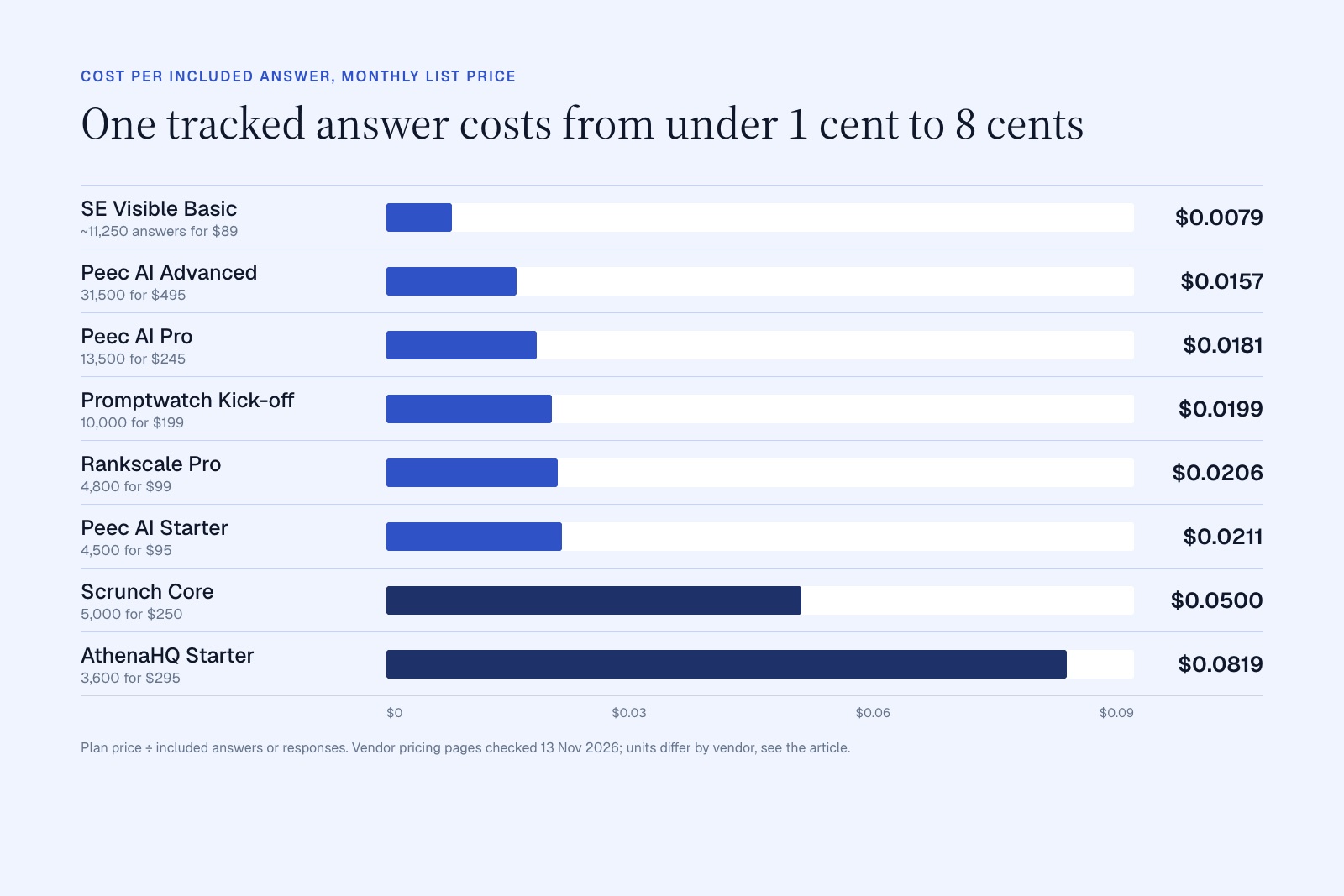
Publicly listed 2026 prices illustrate why entitlement comparison matters. Peec lists Starter at $95 per month with 50 prompts and three models, while Scrunch lists Core at $250 per month with 125 unique prompts, 5,000 responses per month, five users and one workspace.[3] Semrush documents a $99-per-month AI Visibility Toolkit and lists $60 per month for each additional 50 tracking prompts, plus another $99 licence for each corporate subuser requiring access.[4] Profound’s paid Enterprise price is custom rather than publicly stated.[5]
Otterly’s credit model further demonstrates why nominal plan prices can mislead. Its November 2026 documentation shows that the number of prompts supported can vary with the selected engine configuration, even within the same plan.[6] Every quote should therefore state the exact execution volume and engine mix.
What can a worked cost example look like?
The following example is an illustrative assumption, not a vendor quote.
| Assumption | Amount |
|---|---|
| Six-month platform subscription | €6,000 |
| One-time onboarding and integration estimate | €1,500 |
| Internal setup: 24 hours at €75 loaded hourly cost | €1,800 |
| Monthly monitoring and reporting: 10 hours × 6 months × €75 | €4,500 |
| Content and technical work triggered by findings | Excluded from platform TCO; budget separately |
| Illustrative six-month pilot TCO | €13,800 |
The calculation is:
[ \text{Pilot TCO} = €6{,}000 + €1{,}500 + €1{,}800 + €4{,}500 = €13{,}800 ]
If the pilot’s primary objective is operating efficiency, the break-even calculation should use verified savings rather than theoretical capacity. At €75 per internal hour, the pilot would need to release approximately 184 hours to offset €13,800:
[ €13{,}800 \div €75 = 184\text{ hours} ]
That does not mean 184 hours automatically become cash savings. If the team uses the released time for additional analysis, the benefit is capacity released, not expenditure avoided. The business case should label it accordingly.
If the objective is commercial, calculate identifiable AI-referred sessions, conversions, qualified leads or orders using the company’s own definitions. Keep observed channel value separate from incremental value: a tracked AI visit does not prove that the platform caused the visit or that the outcome would not otherwise have happened.
How should AI visibility benefits be measured honestly?
A useful scorecard contains leading indicators and business outcomes without conflating them.
| Measure | Definition | What it can support |
|---|---|---|
| Manual monitoring effort | Time required to complete the same checks before and during the pilot | Operating-efficiency case |
| Brand answer-presence rate | Valid answers mentioning the brand divided by valid answers sampled | Leading visibility indicator |
| Citation-presence rate | Valid answers citing the brand’s domain divided by valid answers sampled | Source visibility and content prioritization |
| Competitive share of voice | Brand appearances relative to the selected competitors and prompt set | Relative position within the defined sample |
| AI-referred sessions | Visits recognized as originating from AI assistants | Clicked-traffic measurement |
| AI conversion rate | Defined conversion events divided by identifiable AI sessions | Local channel-quality evidence |
| Revenue or pipeline | Orders, qualified leads or revenue linked under documented rules | Commercial contribution |
| Answer quality | Accuracy, freshness and material brand representation in reviewed answers | Safety and quality guardrail |
Google Analytics introduced an AI Assistant default channel in 2026, with recognized assistant referrals assigned the ai-assistant medium.[7][8] A referral-only report is therefore incomplete if it ignores this native channel. Google’s documentation also distinguishes AI Assistant traffic from Google AI Overviews and AI Mode, so those surfaces should not automatically be treated as the same reporting stream.[1][9]
Google Search Console’s 2026 generative-AI performance reporting adds visibility into features including AI Overviews and AI Mode.[10] That is useful for search-feature measurement, but it does not create a complete census of every answer exposure or establish that a monitoring platform caused a later conversion.
What AI referral traffic data can and cannot prove
What does AI referral traffic prove?
AI referral traffic can show that a visit reached the website with an identifiable assistant source, what landing page received the visit, and—when analytics is configured correctly—whether the session produced a defined event, lead, order or revenue value.[1]
It cannot show every time a brand appeared in an answer, because an answer may cite a page without generating a click. It also cannot reliably identify every AI-originated visit: missing referrers can be classified as direct or (direct) / (none), and privacy controls, applications, browsers and extensions can omit referral information.[11] Finseo’s own review of six studies on the AI attribution gap (Finseo is built by the team behind this site) puts the share of AI-driven conversions that analytics records at about 1 in 10, and describes a post-purchase survey as one way to close that gap.
A citation collected from a sampled answer is not a page view. Google defines a page view around a page load or related browser-history change, so dividing website visits by observed citations would not produce a real-user citation-through rate.[7]
AI referral data also does not prove incrementality. A visit may have occurred without the platform, and an observed conversion may reflect prior brand awareness, other marketing activity or an existing user journey. Use a documented comparison or holdout where feasible.
Which claims should the business case avoid?
Avoid these formulations:
- “The platform will increase conversions by 23x.” Ahrefs reported a 23x result for its own site, where AI represented 0.5% of traffic and 12.1% of signups; that is a case study, not a market-wide benchmark.[12]
- “AI traffic always converts better than organic search.” Usermaven’s B2B SaaS study found the opposite same-session relationship in its sample.[1]
- “The platform will recover the clicks lost to AI Overviews.” Ahrefs associated AI Overviews with a 58% lower position-one CTR against a modeled counterfactual, but that is evidence of a measurement and traffic risk—not proof that monitoring software recovers those clicks.[12]
- “Visibility equals reach.” Ahrefs describes modeled visibility as potential visibility rather than actual audience reach.[13]
- “A higher share of answers equals incremental revenue.” Share of voice is relative to the selected competitors and prompts, not a count of people reached.
- “All AI referrals are captured in GA4.” Referrers can be omitted, and recognized AI Assistant traffic is not the same as every AI-generated exposure.[9][7]
- “A larger external growth percentage is our opportunity.” Similarweb’s figures use specific sites, periods and methodologies; they should frame relevance, not substitute for first-party sizing.
A credible approval case uses language such as “we will test,” “identifiable AI-referred sessions,” “fixed sampled cohort,” “observed conversion,” and “renewal conditional on.” It avoids “guaranteed uplift,” “recovered revenue,” “total AI reach,” and “caused by the platform” unless the evidence genuinely supports those statements.
How should the pilot success metric be selected?
Select one primary metric and use the others as supporting evidence.
For a low-traffic B2B site, choose verified monitoring effort saved. This can be measured quickly and does not require enough AI sessions to produce a stable conversion rate.
For a brand with meaningful AI referrals, choose a commercial metric such as qualified AI-referred leads per month, with absolute sessions and conversion counts reported beside the rate. Usermaven’s study found 136,080 identifiable AI sessions and 2,389 conversions across its sample, showing why denominators should accompany percentages.[1]
For a visibility-led pilot, choose a fixed-cohort answer-presence or citation-presence target. Keep the prompt set, engines, markets, cadence and competitor set unchanged, and report answer quality as a guardrail.
The strongest approval design may combine one primary measure with two stop conditions:
- Primary target: 20% reduction in verified monitoring time.
- Quality guardrail: no decline in answer accuracy across the reviewed sample.
- Renewal condition: continue only if the annualized cost is lower than the verified operational value or the platform demonstrates a separately approved commercial contribution.
Frequently asked questions
Is an AI visibility platform worth the cost?
It can be worth the cost when it replaces a costly manual process, supports a defined visibility decision, or helps connect meaningful AI-referred activity with business outcomes. The approval case should be based on the company’s workload, coverage requirements and measured pilot result rather than a generic industry conversion multiplier.[9][1]
How do you calculate AI visibility ROI?
Calculate total cost of ownership first, including subscription, seats, usage, onboarding, internal time and implementation work. Then compare that cost with verified operating savings, measured capacity released, or documented commercial value, while keeping observed channel value separate from incremental value.
What should an AI search visibility budget include?
Include the licence, required prompts and engines, markets, seats, extra credits or responses, integrations, onboarding, internal monitoring time, reporting, security review, and the work required to act on findings. Vendor plans differ materially in their purchasing units and seat rules.[4]
Can GA4 measure traffic from ChatGPT and other AI assistants?
GA4 can identify recognized assistant referrals through its AI Assistant channel and the `ai-assistant` medium.[7] It cannot identify every AI-originated visit, every answer exposure or every citation that was never clicked.[14][15]
Does AI visibility cause more revenue?
Visibility alone does not establish causality. A platform may show mentions, citations or competitor gaps, while revenue requires a separate measurement of identifiable visits, conversions, pipeline or orders and—ideally—a credible comparison.
What is a good pilot success metric for an AI visibility platform?
Use the metric closest to the business problem: verified monitoring hours saved for an efficiency case, fixed-cohort answer or citation presence for a visibility case, or qualified AI-referred conversions for a commercial case. Set the metric and denominator before the pilot begins, and add answer quality as a guardrail.
Sources
- [1]We analyzed 15.4 million B2B SaaS sessions. Here’s what we found about AI referrals — usermaven.com
- [2]AI Referral Traffic Winners By Industry | Similarweb — similarweb.com
- [3]Scrunch | Pricing — scrunch.com
- [4]AI Visibility Toolkit: Boost Brand Visibility in AI Search — semrush.com
- [5]Pricing | Profound — tryprofound.com
- [6]New OtterlyAI Pricing: Same Price, More Prompts, Your Engines — otterly.ai
- [7]AI Assistant vs. Organic Search Traffic: How AI Is Reshaping the Customer Journey — a.trkkn.com
- [8]What's new in Google Analytics - Analytics Help — support.google.com
- [9]Does LLM Traffic Convert Better Than Organic? A New Data-Backed Study | Amsive — amsive.com
- [10]Introducing Search Generative AI performance reports in Search Console | Google Search Central Blog | Google for Developers — developers.google.com
- [11]Identify Google Search Traffic in Analytics and Logs | Google Search Central | Documentation | Google for Developers — developers.google.com
- [12]Does AI Search Traffic Convert Better Than Traditional Search? For Ahrefs, Yes: 0.5% of Visitors Drove 12.1% of Signups — ahrefs.com
- [13]Ahrefs Brand Radar Methodology: How we collect and model AI visibility data — ahrefs.com
- [14]AIO Impact on Google CTR: September 2025 Update — seerinteractive.com
- [15]Do people click on links in Google AI summaries? | Pew Research Center — pewresearch.org
- [16]OtterlyAI Pricing - Transparent & Simple — otterly.ai
- [17]Investigating Click Behaviors On Google Search Result Pages That Produce an AI Overview — arxiv.org