Summarize with ChatGPT Claude Perplexity
TL;DR
- A SOC 2 or ISO 27001 claim is only meaningful when the vendor provides the report or certificate scope, covered entity, assessment period and exceptions.[11]
- GDPR compliance does not guarantee EU-only hosting, so buyers should require written locations for production data, backups, logs, support access and subprocessors.[22][11]
- Article 28 requires written processor controls and governs how subprocessors are authorised, changed and bound by equivalent obligations.[34]
- AI visibility vendors should disclose whether each engine is queried through an official API, browser automation, a public interface or another method because platform terms differ.[26]
- SSO, DPA and trust-centre materials are useful starting points, but approval should depend on documentary evidence and contractual commitments covering assurance, data flows and collection authorisation.
AI visibility procurement should assess three separate issues: the vendor’s own security assurance, where each data class is processed, and how the vendor obtains AI-generated answers. A SOC 2 or ISO 27001 claim can support the first question, but it does not automatically prove EU-only hosting, lawful international transfers, or authorized collection from AI platforms.
The safest buying process requires documentary evidence before approval: the applicable audit report or certificate, a signed DPA, a complete subprocessor schedule, a data-flow map, identity-control details, retention commitments, and a platform-by-platform explanation of answer collection.
This checklist covers published security claims from 12 AI visibility vendors. “Not published” means the reviewed public materials did not provide the information; it does not prove that the vendor has no additional restricted documentation.
What should an AI visibility vendor prove?
A vendor should distinguish its own assurance from the certifications of its cloud providers. Rankscale, for example, identifies Google Cloud Platform’s ISO 27001, ISO 27017, ISO 27018 and SOC 2 Type II credentials, but those are GCP certifications rather than Rankscale’s own audit.[1]
Buyers should request:
- The exact legal entity covered by each report or certificate.
- The framework and type, such as SOC 2 Type I or Type II.
- The audit or examination period.
- The systems, products and locations in scope.
- Exceptions, qualified findings or complementary user-entity controls.
- The process for reviewing the report under confidentiality.
- The current subprocessor list and change-notification procedure.
- A written explanation of how AI answers are collected.
A trust-centre badge is useful for triage, but it is not a substitute for the underlying report, certificate scope or contractual commitments. Peec AI publicly announced a SOC 2 Type II examination covering March 30 to June 30, 2026, while Otterly.AI says its SOC 2 Type II audit is on its roadmap with no date set.[2]
Which AI visibility tools like Profound, Peec AI, Otterly.AI and Ahrefs Brand Radar publish SOC 2, ISO 27001 or GDPR claims?
The table below records public statements found in the reviewed materials. “Certification not published” means the reviewed source did not establish a certificate or report of that type.
| Vendor | Published security or compliance statement | What is not established publicly |
|---|---|---|
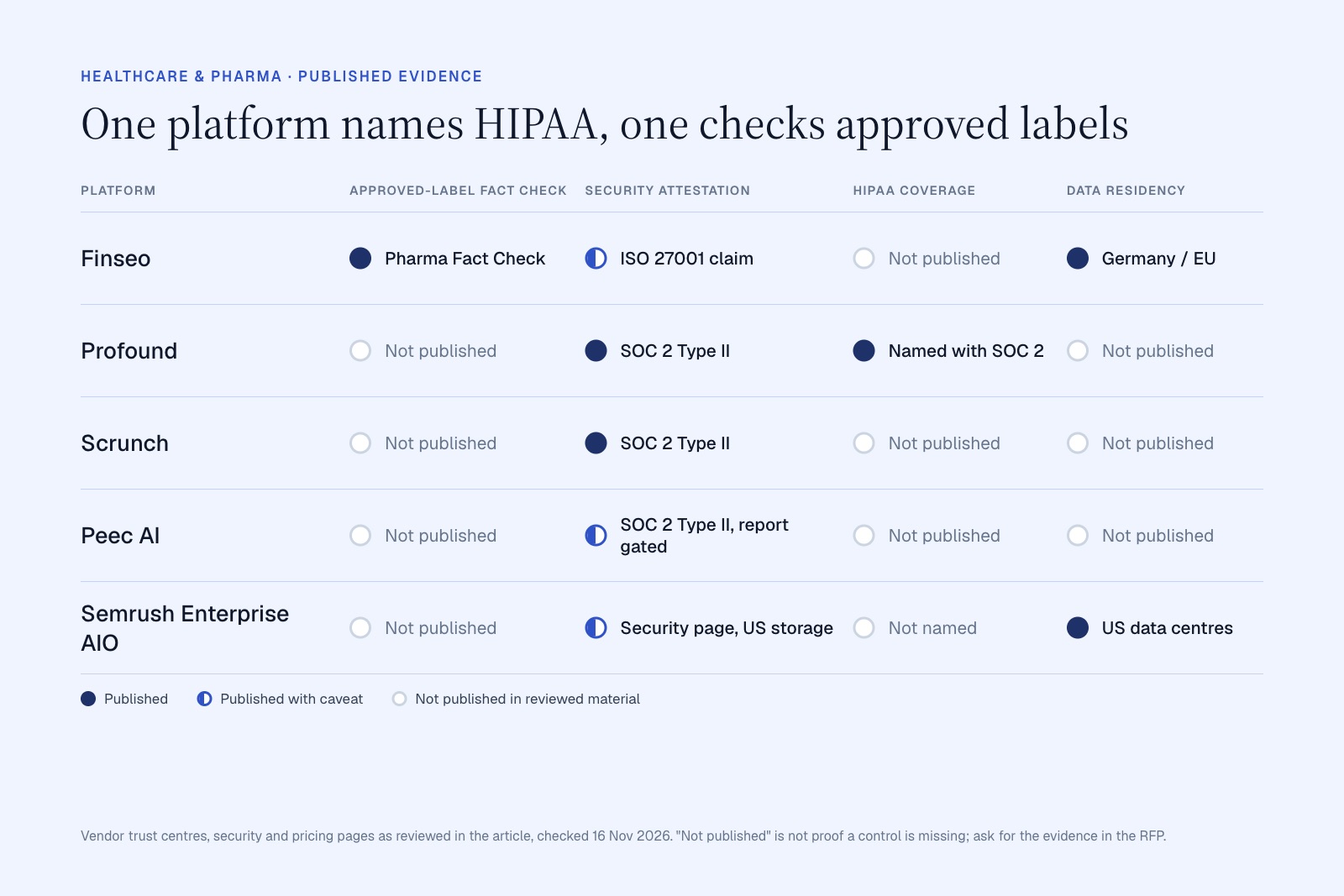
| Finseo | Its trust materials say its information-security management system is based on ISO/IEC 27001:2022 and that ISO 27001 has been implemented.[3] | Explicit ISO certification status, SOC 2 and a specific GDPR certification were not published in the reviewed materials.[1] |
| Profound | Trust Center lists SOC 2 Type 2, HIPAA and a web-application penetration test.[4][5] | The DPA’s references to ISO 27001, NIST 800-53 or equivalent standards are not evidence of an ISO certificate.[6] |
| Peec AI | Trust Center lists GDPR and SOC 2 Type II; Peec announced a completed SOC 2 Type II examination for March 30–June 30, 2026.[2] | The reviewed materials did not establish an EU-only hosting commitment.[7][8] |
| Otterly.AI | Claims GDPR and CCPA compliance and says it operates according to SOC 2 and ISO 27001 principles.[9] | SOC 2 Type II audit has no announced date, and ISO certification is described as pending.[9] |
| Semrush AI Visibility Toolkit | Semrush says its products adhere to GDPR and publishes a DPA.[10] | A Semrush SOC 2 or ISO 27001 report was not published in the reviewed security material.[3][1] |
| Ahrefs Brand Radar | Trust materials list ISO 27001 from 2022 and SOC 2.[11] | The SOC 2 type was not specified in the reviewed excerpt.[12] |
| Scrunch | Trust Center lists SOC 2 materials and states that buyers can request current SOC 2 Type II audit reports and certification status.[13] | The reviewed excerpts did not settle the current report status. |
| Promptwatch | Promptwatch identifies Promptwatch B.V. as the GDPR controller.[14] | A SOC 2, ISO 27001 or GDPR certification claim was not published in the reviewed security disclosure.[1] |
| AthenaHQ | Trust Center lists GDPR, SOC 2 Type I and SOC 2 Type II, including a report labelled 2025.[15][7] | The reviewed materials did not establish a specific hosting region or EU-only promise. |
| SE Ranking / SE Visible | Privacy materials identify processors, including Google LLC in the United States.[16] | A SOC 2 or ISO 27001 statement was not published in the reviewed privacy materials. |
| Rankscale | Its policy cites GCP’s ISO 27001/27017/27018 and SOC 2 Type II credentials.[1] | Those are cloud-provider credentials, not a Rankscale SOC 2 or ISO 27001 report.[1] |
| Writesonic | Trust Center labels SOC 2, GDPR and HIPAA as compliant.[5] | SOC 2 type and a public SOC 2 report were not published in the reviewed materials.[1] |
Finseo is included here as one vendor in the market, not as a recommendation. Finseo is built by the team behind this site.
What does GDPR require from an AI visibility processor?
GDPR requires controllers to use processors that provide sufficient guarantees for appropriate technical and organisational measures. The processor relationship must be governed by a binding contract covering matters such as the processing subject matter, duration, purposes, data types, data-subject categories and the controller’s rights and duties.[17]
The DPA should match the actual service. It should explain whether the vendor processes:
- Prompts and prompt libraries.
- AI-generated answers and citations.
- User names, email addresses and account details.
- Analytics, conversion and attribution data, for example when a tool matches AI referral sessions to closed revenue through a GA4 or Piwik PRO connection.
- Support tickets and uploaded files.
- Logs, telemetry and security events.
- Data sent to model providers or other subprocessors.
A DPA alone does not prove where data is hosted or whether the vendor’s collection method complies with an AI platform’s terms. Profound’s DPA identifies U.S. cloud infrastructure and AI model providers, Writesonic’s DPA lists U.S. Azure hosting, and Semrush describes vendor agreements and compliance procedures.[18]
How should subprocessors be controlled?
GDPR Article 28 requires prior specific or general written authorisation before a processor engages another processor. With general authorisation, the processor must notify the controller of intended additions or replacements and provide an opportunity to object; equivalent data-protection obligations must flow down to the next processor.[19]
Before signing, request:
- The current subprocessor list.
- Each subprocessor’s service and processing purpose.
- The processing location and transfer mechanism.
- Advance-notice periods for changes.
- The objection process and available remedies.
- Deletion or return obligations.
- Audit and information rights.
- The vendor’s responsibility for subprocessor failures.
Where do AI visibility platforms like Semrush, Otterly.AI and Profound store customer data?
GDPR compliance does not mean that every data class remains in the European Economic Area. International transfers can rely on mechanisms including adequacy decisions and appropriate safeguards such as standard contractual clauses.[20]
Ask for locations separately for production databases, backups, logs, telemetry, support access, disaster recovery and model-provider processing. Published disclosures show why a single regional label can be misleading:
| Vendor | Published location disclosure | Procurement question |
|---|---|---|
| Semrush | Service data is stored in physically secure U.S. data centres; AWS, Google Cloud Platform and Digital Realty are named.[1][21] | Does this cover prompts, outputs, backups, logs and support access? |
| Otterly.AI | AWS hosting is identified in Frankfurt, while public monitoring data is stored in Northern Virginia.[22] | Which data classes are stored in each location? |
| Rankscale | The service is hosted on GCP, with its primary data centre in Iowa, U.S.[1] | Is an EEA-only deployment or contractual commitment available? |
| Writesonic | Azure is identified for primary cloud hosting, storage, networking and compute in the United States.[23] | Does this cover all service components and subprocessors? |
| Profound | Its DPA names U.S. cloud infrastructure and Anthropic.[6] | Where does each named provider process prompts and outputs? |
| SE Ranking | Its processor list names Google LLC in the United States for several functions.[16] | Is this the complete production and support data flow? |
| Ahrefs | Production databases replicate across multiple availability zones and regions, with continuous backups.[11] | Which regions contain the customer’s tenant and backups? |
If EEA-only processing is mandatory, require an express contractual commitment that covers production, backups, logs, support access and subprocessors. Do not treat a vendor’s general GDPR statement as an EU-residency guarantee.
Do AI visibility tools track ChatGPT, Perplexity and Google through scraping or official APIs?
Collection method affects legal risk, measurement fidelity and reproducibility. Some vendors describe browser automation or public-interface collection; others use APIs for particular engines; several reviewed vendors do not publish the method.
| Collection method | Published examples | Questions to ask |
|---|---|---|
| Browser or public-interface collection | Profound, Peec AI, SE Visible and Ahrefs describe browser or public-web collection.[24] | Which account, region, product tier, personalisation and rate controls are used? |
| Hybrid collection | Scrunch, Promptwatch and Rankscale describe combinations of browser automation and APIs.[25] | Which method applies to each engine and product surface? |
| Live requests without LLM APIs | Semrush says responses come from real requests rather than LLM APIs.[21] | What interface is used, and is automated access permitted? |
| Method not published | Finseo, AthenaHQ and Writesonic do not specify API versus browser collection in the reviewed materials.[25][26] | Require a written platform-by-platform method statement. |
Why scraping versus official APIs matters
Browser collection may measure the experience shown through a public interface, but it can also raise questions about account use, rate limits, automated-access rules, personalisation and terms of service. API collection may be more structured and predictable, but API output may differ from the consumer interface being studied. Academic research describes both permission risks and reliability differences between scraping and API-based collection.[27]
Ask the vendor to document the engine, endpoint or interface, account type, authorization basis, regional settings, rate controls, data retained and change-notification process. Require the vendor to disclose when it changes from browser collection to an API, or the reverse.
OpenAI’s consumer terms prohibit automatically or programmatically extracting data or output, while separate business and API terms govern other services.[28] Anthropic’s consumer terms restrict scraping and automated access except through an API key or where explicitly permitted, and its commercial terms restrict using the services to build a competing product.[29] Perplexity’s consumer terms restrict robots, crawlers, scrapers and automated collection, while its API is governed separately.[30]
Google’s terms address automated access that violates machine-readable instructions, and Google’s Search spam policy says scraping search results for rank-checking or other automated access without express permission violates its policies and terms.[31] A vendor should therefore identify whether Google-related measurements come from an authorised API, a permitted product surface or automated results-page access.
Which AI visibility platforms offer SSO and audit logs for enterprise and agency teams?
SSO is usually a plan and configuration question rather than a universal platform capability. Profound advertises SSO/SAML, and Peec AI describes SAML SSO and role-based access.[2]
Confirm:
- Whether SSO/SAML is included in the purchased plan.
- Which identity providers are supported.
- Whether SSO can be enforced for every user.
- Whether MFA is available or inherited from the identity provider.
- How roles and least privilege are configured.
- Whether audit logs record logins, exports, permission changes and data access.
- How long logs are retained.
- Whether client or agency users receive separate permissions.
Do not infer enterprise controls from a marketing page alone. Ask for the applicable SKU, implementation requirements, log fields, retention period and export capabilities.
How should you score an AI visibility vendor before approval?
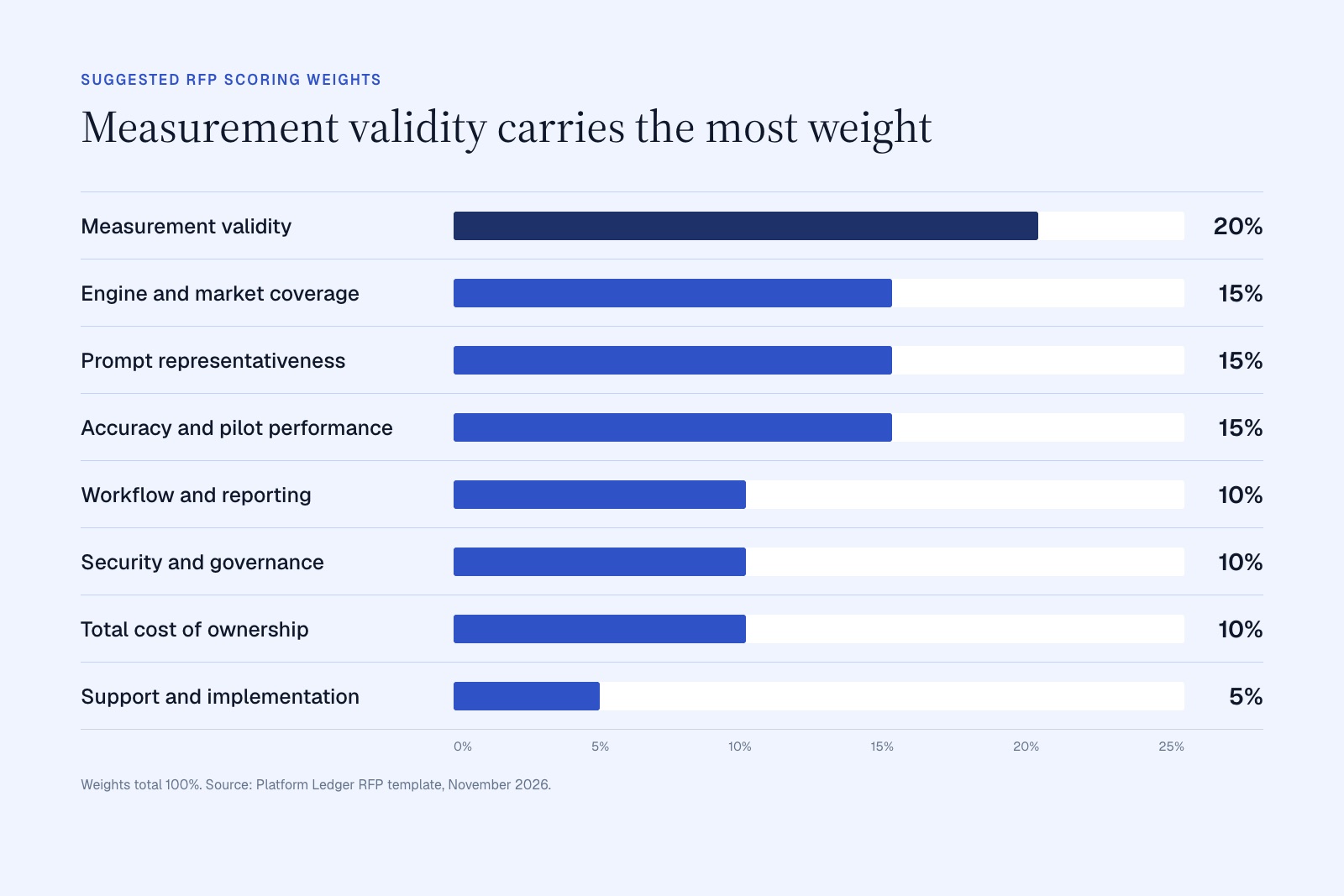
Use this numbered checklist as a procurement gate:
- Obtain the exact SOC 2 report, ISO certificate or equivalent assurance artifact, including scope, legal entity, period and exceptions.
- Separate the vendor’s own assurance from certifications held by its cloud providers.
- Require a signed Article 28 DPA covering purposes, data types, data subjects, duration, instructions and controller rights.[17]
- Review the current subprocessor schedule, locations, notice period, objection process and contractual flow-down.
- Request a data-flow map covering prompts, outputs, account data, analytics, logs, backups, support and model-provider processing.
- Obtain an explicit residency commitment if EEA-only processing is required.
- Ask how each AI engine is queried: official API, browser automation, public interface, search-results page or another method.
- Require the vendor to identify the account type, authorisation basis, region, rate limits and terms applicable to each collection path.
- Confirm whether SSO/SAML, MFA, RBAC and audit logs are included in the purchased plan.
- Ask for retention, deletion, return, backup-expiry and incident-notification commitments.
- Confirm whether customer prompts or outputs are used for model training, product improvement or benchmarking.
- Make unresolved answers contractual approval conditions rather than informal sales assurances.
Which vendors disclose the most useful procurement evidence?
Published evidence is uneven and should not be treated as a ranking of actual security. Peec AI publishes relatively specific SOC 2 Type II information and SAML/RBAC claims; Profound publishes SOC 2 Type 2 and SSO/SAML information; AthenaHQ lists SOC 2 Type I and Type II materials; and Ahrefs lists ISO 27001 and SOC 2 without specifying the SOC 2 type in the reviewed excerpt.[2]
Otterly.AI is comparatively explicit that its SOC 2 Type II audit is not yet complete, while Rankscale distinguishes its own service from GCP’s certifications.[1] Finseo describes ISO-aligned implementation but does not establish an explicit certificate in the reviewed materials.[9] Writesonic labels SOC 2, GDPR and HIPAA as compliant without publishing a SOC 2 type or report in the reviewed source.[5][32]
The most defensible shortlist is not necessarily the vendor with the longest badge list. It is the set of vendors that can document the controls, locations, collection methods and contractual commitments required by the buyer’s risk profile.
Frequently asked questions
Does GDPR compliance mean an AI visibility platform stores data in the EU?
No. GDPR permits certain international transfers using mechanisms such as adequacy decisions and standard contractual clauses.[20][33] Require a written EEA-only commitment if prompts, outputs, logs, backups and support access must remain in the region.
Is SOC 2 Type II the same as ISO 27001?
No. They are different assurance frameworks with different structures and evidence. A buyer should request the exact report or certificate, its scope, covered entity, assessment period and exceptions rather than relying on a generic security badge.
Should an AI visibility vendor disclose whether it scrapes answers?
Yes. The collection method affects platform terms, account permissions, rate limits, reproducibility and what user experience is actually measured. Ask for an engine-by-engine statement covering APIs, browser automation, public interfaces and any planned methodology changes.[25][26]
Does a cloud provider’s ISO 27001 or SOC 2 certification cover the SaaS vendor?
No. Cloud-provider assurance describes the provider’s controls, not necessarily the SaaS vendor’s organisation, application or operating procedures. Rankscale’s policy illustrates the distinction by citing GCP certifications while describing Rankscale’s service separately.[1]
What should an AI visibility vendor’s DPA include?
It should identify the processing purposes, duration, data types, data-subject categories, controller instructions and rights, along with processor obligations. It should also explain subprocessors, change notices, objections, security assistance, deletion or return and audit information.[13]
Is SSO enough to prove that an AI visibility platform is secure?
No. SSO reduces account-access risk but does not establish secure collection, lawful transfers, retention controls, subprocessor governance or application security. Confirm SSO’s plan availability, enforcement, role model and audit logging alongside the vendor’s assurance and data-flow evidence.[9][2]
Which AI visibility vendors publish SOC 2 Type II information?
Peec AI announced a completed SOC 2 Type II examination covering March 30 to June 30, 2026, and Profound’s Trust Center lists SOC 2 Type 2.[2] AthenaHQ lists SOC 2 Type I and Type II materials. Otterly.AI says its SOC 2 Type II audit is on its roadmap with no date set.[9]
Does the Semrush AI Visibility Toolkit use LLM APIs?
Semrush says its responses come from real requests rather than LLM APIs.[21] Semrush says its products adhere to GDPR and publishes a DPA. It states that service data is stored in U.S. data centres, naming AWS, Google Cloud Platform and Digital Realty.[1]
Does Ahrefs Brand Radar have SOC 2 and ISO 27001?
Ahrefs trust materials list ISO 27001 from 2022 and SOC 2, but the SOC 2 type was not specified in the reviewed excerpt.[11] Ahrefs describes browser or public-web collection. It also says production databases replicate across multiple availability zones and regions with continuous backups.[11]
Sources
- [1]Privacy Policy - Rankscale — rankscale.ai
- [2]Peec AI Completes SOC 2 Type II Examination, Making Its AI — globenewswire.com
- [3]Overview — app.secfix.com
- [4]Trust Center - Scrunch — trust.scrunchai.com
- [5]Writesonic - Trust Center - Security & Privacy — trust.writesonic.com
- [6]Data Processing Agreement | Profound — tryprofound.com
- [7]Trust Center - peec.ai — trust.peec.ai
- [8]Welcome to Peec AI - Peec.ai Docs — docs.peec.ai
- [9]Is OtterlyAI ISO-27001 or SOC-2 compliant? — help.otterly.ai
- [10]Semrush Security Info — semrush.com
- [11]Compliance at Ahrefs. — trust.ahrefs.com
- [12]Ahrefs Brand Radar Methodology: How we collect and model AI visibility data — ahrefs.com
- [13]Scrunch | FAQs - Is Scrunch SOC 2 Type II compliant and what security standards does it meet? — scrunch.com
- [14]Privacy Policy | Promptwatch — promptwatch.com
- [15]Trust Center - AthenaHQ — trust.athenahq.ai
- [16]PROCESSORS - SE Ranking — seranking.com
- [17]A Practical Guide to Controller-Processor Contracts | Data Protection Commission — dataprotection.ie
- [18]Data Processing Addendum — semrush.com
- [19]Regulation - 2016/679 - EN - gdpr - EUR-Lex — eur-lex.europa.eu
- [20]International data transfers | Data protection guide for small business | European Data Protection Board — edpb.europa.eu
- [21]Where does the data in Semrush’s AI Visibility Toolkit come from? — semrush.com
- [22]OtterlyAI - Security — otterly.ai
- [23]AI Search Visibility Tracking & Optimization Platform | Writesonic — writesonic.com
- [24]SE Visible FAQ – Knowledge Base — help.seranking.com
- [25]Scrunch | FAQs - What methods does Scrunch use to collect data from AI platforms? — scrunch.com
- [26]API Benchmark Scores Do Not Reliably Transfer to Chatbot Interfaces — aclanthology.org
- [27]Web scraping for research: Legal, ethical, institutional, and scientific considerations - Megan A Brown, Andrew Gruen, Gabe Maldoff, Solomon Messing, Zeve Sanderson, Michael Zimmer, 2025 — journals.sagepub.com
- [28]Terms of Use | OpenAI — openai.com
- [29]Consumer Terms of Service \ Anthropic — anthropic.com
- [30]Perplexity Terms of Service — perplexity.ai
- [31]Spam Policies for Google Web Search | Google Search Central | Documentation | Google for Developers — developers.google.com
- [32]Compliance frameworks followed by Writesonic — trust.writesonic.com
- [33]EUR-Lex - 02016R0679-20160504 - EN - EUR-Lex — eur-lex.europa.eu
- [34]Controller and Processor relationships | Data Protection Commission — dataprotection.ie